Rechercher dans ce blog

Tuesday, June 2, 2020

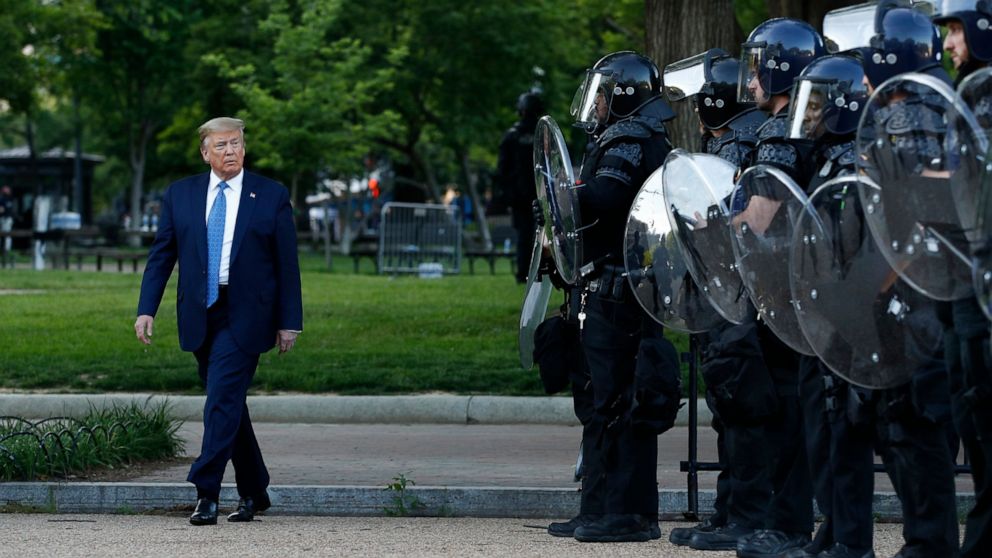
Trump as thug or hero? Depends on what network you watch - ABC News

Is President Donald Trump a thug, a modern-day dictator

NEW YORK -- It was a split screen for the ages on MSNBC Monday: on the left side, President Donald Trump talking about restoring law and order. On the right, a tear-gassed young woman vomiting in a Washington street.

For a nation rubbed raw following a traumatic weekend, cable television news did little to promote peace, love and understanding in its most-watched hours

Fox News Channel, CNN and MSNBC poke and prod the nation's divide on most nights, and each has been amply rewarded in the ratings. Trump's stern speech and walk to a nearby church after protesters were forcibly cleared out of the way Monday raised the temperature on those networks even higher.

“The president seems to think that dominating black people, dominating peaceful protesters, is law and order,” CNN's Anderson Cooper said. “It's not. He calls them thugs. Who's the thug here?”

At the same time on Fox News Channel, Tucker Carlson said that Trump provided “a powerful symbolic gesture, a declaration that this country, our national symbols, our oldest institutions, will not be desecrated and defeated by nihilistic destruction.”

For the most part, the television commentators talked past each other to vastly different audiences. CNN and MSNBC concentrated on peaceful protests in the wake of George Floyd's death at the hands of police; the Fox News focus was on violence and property destruction in the streets.

The same arguments have animated American politics for decades, but cable news uses megaphones to amplify them.

Trump has the full authority to use the federal government to go into states to restore order, Fox's Sean Hannity said.

“If the liberal mayors or governors in most cases are unwilling and unable to protect their own citizens, the federal government will,” he said.

Not so fast, Rachel Maddow said on MSNBC.

“While there are depths that even the most doomsday predictions about the Trump presidency did not plumb, this rubicon moment arrived tonight in the haphazard and slipshod way that has become familiar for most of the other previously unimaginable dark turns this country has taken since Mr. Trump has become president,” she said.

CNN's Chris Cuomo concluded of Trump: “This is who he is, and it's not what the country needs right now.”

“You're not surprised, are you?” his colleague Don Lemon said.

Trump came off Monday as “a modern-day dictator,” Lemon said.

But the headline on Fox News at that moment was “Chaos Blankets American Streets.” Reporter Bryan Llenas showed pictures of broken glass in front of storefronts littering New York City streets.

Criminals and domestic terrorists are using George Floyd “to try to murder America,” host Laura Ingraham said.

“The president tonight reaffirmed his duty to defend the Constitution,” she said.

———

AP Television Writer Lynn Elber in Los Angeles contributed to this report.

Let's block ads! (Why?)


"network" - Google News
June 02, 2020 at 10:51AM
https://ift.tt/3dpuki7

Trump as thug or hero? Depends on what network you watch - ABC News
"network" - Google News
https://ift.tt/2v9ojEM
Shoes Man Tutorial
Pos News Update
Meme Update
Korean Entertainment News
Japan News Update


Monday, June 1, 2020

Rivian Adventure Network: electric pickup maker hires Tesla staff to build charging network - Electrek

The charging experience is really important for the success of electric vehicles and automakers have widely different approaches. Rivian, an electric pickup truck startup, is betting on its own network and it is hiring from the leader, Tesla, to build it out.

One of Tesla’s greatest advantages over other automakers in the electric revolution is the fact that it has much greater control over the charging experience than other companies.

While most of the charging happens at home, in order to replace gasoline vehicles, electric automakers need a seamless charging experience on the road to enable long-distance travel.

Most automakers rely on third-party charging networks to provide the charging experience, but early on, Tesla decided to build its own charging network and control the experience with the Supercharger network.

Rivian is taking a similar approach.

Electrek has learned from sources familiar with the matter that the automaker is working on the ‘Rivian Adventure Network’ and it is hiring people who worked on Tesla’s Supercharger network.

In March, Rivian hired Carrington Bradley as Senior Manager of Charging Deployment.

Before joining Rivian, Bradley had been working at Tesla for almost 7 years and most recently, he was managing charging programs at the company.

He wrote about his responsibilities and accomplishments at Tesla on LinkedIn:

“Built and managed a national team of 11 project managers to design, permit, and build electric vehicle Supercharger stations. Under my leadership, the team scaled from 50 to 150 completed sites per year. Globally, the Supercharger network is the largest direct current fast charging network in the world, covering over 1,900 sites and 17,000 parking stalls in 37 countries.”

Around the same time, Rivian also hired Sara Eslinger as ‘Sr. Product Manager, Charging Infrastructure at Rivian’.

Eslinger was hired away from Lyft where she was leading electric vehicle deployment. Prior to working for Lyft, she worked for more than 6 years at Tesla in charging infrastructure.

Rivian has also hired Kit Ahuja as Director of Rivian Adventure Network and he formerly was a manager at Tesla. He more recently worked at Enel X, which is also in the EV charging business.

The automaker has previously mentioned its ambition to build its own charging network:

“We will be building some of our own charging infrastructure, including many of the outdoor destinations for which our vehicles are designed.”

But we now learn some additional details.

For the “adventure” aspect of the network, Rivian will first target off-roading pit-stops, national parks, and RV parks.

When Rivian first unveiled the R1T electric pickup, they were talking about a charge rate of up to 160 kW at fast-charging stations and an 11-kW onboard charger for level 2 charging.

The prototype was equipped with a CCS charge port.

We now learn from sources that Rivian is aiming for its DC charging stations to deliver up to 200 kW and each charger can charge two vehicles at once.

Since Rivian owners will have access to all third-Party networks with CCS chargers, the automaker is going to focus on remote locations to close the gap and enable adventures in the wild.

For example, we are told that the company is aiming for one of its first Rivian-branded charging stations to be located in Moab, Utah.

The first sites are supposed to come online next year.

Electrek’s Take

This is awesome news.

I love to hear that Rivian is moving forward with its own charging network and that they are hiring from Tesla to make it happen.

I’ve been saying for a while but when it comes to charging, automakers should just copy Tesla’s approach.

Tesla will be fine. While I’m sure Tesla will miss them, the Supercharger network will keep growing without those employees. I think their experience building out the Supercharger network is probably much more valuable at Rivian right now.

I could see Rivian doing very well with just a few hundreds well located charging stations for adventures across North America and relying on third-party networks, who will have grown significantly by that time, for the rest.

What do you think? Let us know in the comment section below.

FTC: We use income earning auto affiliate links. More.


Subscribe to Electrek on YouTube for exclusive videos and subscribe to the podcast.

Let's block ads! (Why?)


"network" - Google News
June 02, 2020 at 06:50AM
https://ift.tt/2Mh6A3I

Rivian Adventure Network: electric pickup maker hires Tesla staff to build charging network - Electrek
"network" - Google News
https://ift.tt/2v9ojEM
Shoes Man Tutorial
Pos News Update
Meme Update
Korean Entertainment News
Japan News Update

Dish adds T-Mobile veteran Mayo to network team - FierceWireless

Dish Network is adding more wireless industry savvy to its ranks, with former T-Mobile executive Dave Mayo joining as EVP, Network Development.

T-Mobile Dave Mayo (T-Mobile)
Dave Mayo 

Prior to joining Dish, Mayo most recently was senior vice president at T-Mobile USA, where he led T-Mobile’s IoT business and founded the company’s fixed wireless business.

At Dish, Mayo is responsible for Dish's wireless buildout strategy and execution of the company's deployment of a standalone (SA) 5G network. His official start date was June 1 and he reports direct to Dish co-founder and Chairman Charlie Ergen.

Mayo’s career in wireless dates back to T-Mobile’s predecessor, Western Wireless, which was founded by John Stanton and Theresa Gillespie in 1994. That eventually led to VoiceStream Wireless, which was purchased by Deutsche Telekom and renamed T-Mobile USA.

During the course of his career, Mayo gained experience in a host of areas: network strategy, planning and implementation, development, financial analysis, operations, strategic transactions, vendor management and most recently, 5G, IoT and fixed wireless.

Sponsored by Qualcomm

How Does Support for Unlicensed Spectrum With NR-U Transform What 5G Can Do for You?

Thursday, June 11, 2020 | 12pm ET | 9am PT
Join this webinar to learn how NR-U can help service providers deliver the 5G experience end-users have come to expect, 5G private networks can be deployed without spectrum licenses to address unmet needs and how NR-U brings the power of high-performance 5G to a wider range of industrial Internet of things (IIoT) deployments

His hire comes after Dish last year added Nokia veteran Marc Rouanne as chief network officer and Stephen Bye as chief commercial officer.

RELATED: Meet the T-Mobile executive in charge of fixed wireless

Dish also announced several other executive changes. Jeff Blum, who oversees state and federal government relations from the company's Washington, D.C. office, was promoted to EVP, External and Legislative Affairs. 

Dish said Blum has played an “integral role” in Dish’s wireless journey, from spectrum acquisitions and regulatory affairs to his most recent work with the Department of Justice and FCC. That work, as part of the remedy to the T-Mobile/Sprint merger, set up Dish to be a fourth facilities-based carrier, as well as an MVNO agreement with T-Mobile.

The remedy also calls for Dish to acquire the Boost Mobile assets from Sprint, a deal that is due to close any day now. (Dish said during its most recent earnings call that it could happen June 1 or get pushed back to July.) 

In the retail space, John Swieringa, Dish's COO since December 2017, will add to his responsibilities as the new Group President, Retail Wireless. Swieringa will be responsible for Dish's retail wireless business, including strategy, operations and sales, in addition to his duties as COO. He will continue to report to Dish CEO Erik Carlson.

RELATED: Dish network build ‘for real,’ says SBA CEO

Dish’s ability to build a greenfield 5G network came into question when the COVID-19 crisis took hold and sent financial markets into a tailspin. But Ergen also addressed that question during the earnings call last month, saying the funding part is not the thing that’s keeping them up at night.  

Dish has said it will build its 5G network on a city-by-city basis and it is aiming for a core and 5G trial service in one market by the end of 2020. 

Let's block ads! (Why?)


"network" - Google News
June 02, 2020 at 04:35AM
https://ift.tt/3dBns1n

Dish adds T-Mobile veteran Mayo to network team - FierceWireless
"network" - Google News
https://ift.tt/2v9ojEM
Shoes Man Tutorial
Pos News Update
Meme Update
Korean Entertainment News
Japan News Update

Three Ways to Protect Your IT Network | Avast - Security Boulevard

There is no question that cloud services and other digital technologies can drive speed and performance, especially for small and mid-size businesses (SMBs) — and SMBs are making the transition in increasing numbers. In fact, data shows nearly half (46%) implemented digital transformation initiatives last year, up from 36% in 2017. An estimated 81% are also changing business models and reshaping processes. 

When you consider that this increase was prior to the work-from-home experiment driven by COVID-19, current numbers are astounding. Today, in the U.S. alone, an estimated 300 million people are under either state or city-mandated shelter-in-place orders. Digital initiatives are now taking center stage, critical to support a growing remote workforce.

Cybercriminals are also in lock step with this work shift, changing tactics to launch cyber scams and attacks to take advantage of new security gaps. 

You can imagine the security implications. The reality is, if security measures don’t keep pace with digital innovation, vulnerabilities and security risks can result. For example, as workforces become more mobile and distributed, and employees have access to a greater range of apps and software, company data no longer sits in one place. This creates new complexities for IT teams tasked with keeping access to cloud apps, portals, and IT networks safe and reducing the attack surface. Securing this changing network perimeter has become a critical challenge. 

In our “SMB Guide to Secure Digital Transformation,” we look at how your attack surface changes as digital initiatives are adopted and why this makes your business vulnerable to cyber risk. We discuss strategies and best practices to better plan and incorporate cybersecurity into your digital transformation strategies.

Identify risks, determine security levels, maintain visibility 

How do SMBs take advantage of digital transformation and empower a remote workforce while remaining secure?  How does IT provide complete security for this complex, changing work environment?

First, cybersecurity should be considered as soon as a digital strategy or work-from-home initiative begins — really, as soon as a business takes its first digital step. Next, the managed security services you choose should have the capabilities to identify any gaps or weaknesses in your IT infrastructure, and at the same time, enable you to scale the security measures as your plans change or expand. 

The key is finding a managed security solution that offers the right set of services to support your initiatives while enabling you to easily manage and scale it without high costs and resources. 

If this sounds like a bigger challenge than digital transformation itself, you’re not alone. Many SMBs may not know where to start when it comes to outlining the security needed for their digital plans. 

Let’s look at three essentials to keep in mind.

  • Identify your needs and vulnerabilities: Determine the digital transformation you want to accomplish and the technologies you plan to adopt. It may be helpful to create a list of everything in your IT infrastructure, and where new security implications or vulnerabilities may result as you add new technologies and processes.
  • Determine the security level you need:  Are you adding cloud services for the first time, expanding remote access, or enforcing new Bring Your Own Device (BYOD) policies? Each initiative requires a different level of managed security. 

For example, if cloud apps are central to your digital plan, you’ll want to prioritize these security measures:

  • Backup and disaster recovery: This enables you to quickly access valuable data in worse case scenarios.
  • Secure web gateway:  This detects and blocks web threats within the network, ensuring that users working in or outside the office can safely access data, files, and services in the cloud.
  • Patch management: This keeps cloud applications updated and free of potential vulnerabilities that may create opportunities for unauthorized access and cyber attacks.
  • Maintain visibility across your IT network: Putting cybersecurity protection in place is just one element of your defense. Cyberthreats are constantly evolving and finding new ways to attack — at the same time, your network is also changing as users connect from new locations, add devices or apps, and more.  That means, monitoring capabilities must be part of your managed security solution to provide the critical 24/7 visibility you need.

Ensuring complete security for the modern workforce

Protecting your business while ensuring the success of your digital transformation strategies not only requires a consistent focus on cybersecurity — but also the right level of security. Balancing protection with detection is critical. Equally important is the ability to easily manage and scale your security as you move forward.

To ensure your cybersecurity supports your digital plans, we created “The SMB Guide to Digital Transformation.” Download it today to ensure your security measures are keeping pace with your cloud strategies and initiatives.

*** This is a Security Bloggers Network syndicated blog from Blog | Avast EN authored by Avast Blog. Read the original post at: https://blog.avast.com/three-ways-to-protect-your-it-network-avast

Let's block ads! (Why?)


"network" - Google News
June 02, 2020 at 02:59AM
https://ift.tt/3dtaToA

Three Ways to Protect Your IT Network | Avast - Security Boulevard
"network" - Google News
https://ift.tt/2v9ojEM
Shoes Man Tutorial
Pos News Update
Meme Update
Korean Entertainment News
Japan News Update

Major Upgrade for Channel Island's Telecom Network - Infosecurity Magazine

Guernsey is to benefit from a major performance upgrade and security enhancement to its telecom network.

British technology and network services company Telent Technology Services Ltd. (telent) has been awarded a contract by Sure to upgrade the service provider’s core network.

Under the contract, Telent will replace Sure’s existing 10G core network with a 100G Juniper Networks core network. The upgrade is being undertaken to allow Sure to deliver faster, more reliable internet connectivity to its consumer and business customers across the island as increasing bandwidth usage and data consumption create what Telent described as "unprecedented demand."

“Growing data consumption means demand for higher network capacity and speed is growing and service providers must ensure they are delivering on that,” said Shani Latif, sales director at Telent. 

“This upgrade for Sure will incorporate the latest technologies to ensure a future-proof network, while our experience and knowledge of the service provider market will minimize customer disruption and ensure work is completed efficiently.”

Once complete, the move to 100G will produce benefits to folks beyond the island's sandy beaches and picturesque bays. As a core network, it will also deliver increased capacity to London and Paris, connecting the Channel Islands to the rest of the world.

The upgrade will provide extra capacity for growth, future-proofing the network as growing and new technologies, including Fiber-to-the-Home (FTTH) and 5G, are rolled out commercially. 

Mindful of the need for cybersecurity, Telent will implement a joint Juniper-Corero Distributed Denial of Service (DDoS) solution to provide real-time, automated DDoS protection.

Sure Group CEO Ian Kelly said that ensuring people can stay connected is more important than ever as the COVID-19 health crisis limps on. 

“The current situation is a clear reminder that telecoms are a key and growing component of our economy and daily lives,” said Kelly. 

“This network upgrade is a significant long-term investment to ensure we can continue to meet customer expectations now and in the future. We are pleased to be working with Telent which has a long history and strong reputation in the design, upgrade, build and maintenance of critical networks.”

Work on the project has already started and is expected to be completed by early 2021.

Let's block ads! (Why?)


"network" - Google News
June 02, 2020 at 01:54AM
https://ift.tt/2ZZrDjo

Major Upgrade for Channel Island's Telecom Network - Infosecurity Magazine
"network" - Google News
https://ift.tt/2v9ojEM
Shoes Man Tutorial
Pos News Update
Meme Update
Korean Entertainment News
Japan News Update

WWE® Introduces the New Free Version Of WWE® Network - Business Wire

STAMFORD, Conn.--()--WWE (NYSE: WWE) today unveiled the Free Version of WWE Network, the company’s award-winning digital streaming service, unlocking a vast portion of its content library with more than 15,000 action-packed WWE titles now available for free, no credit card required.

The Free Version of WWE Network includes:

  • New shows including Raw Talk, streaming Monday nights each week immediately following Raw
  • Groundbreaking original series including Monday Night War, Ride Along, Table for 3, Photo Shoot and Story Time
  • Recent episodes of WWE’s flagship programs Monday Night Raw, Friday Night SmackDown and NXT
  • Select historical WWE pay-per-views and NXT TakeOver events
  • Weekly WWE highlights, Top 10, WWE’s The Bump, WWE Now, The Best of WWE and WWE Timeline

“The launch of WWE Network’s Free Version is a key component of our company’s digitization strategy and a new way for all fans to be able to experience premium WWE content,” said Jayar Donlan, WWE Executive Vice President, Advanced Media. “As we continue to reimagine WWE Network’s offering, the Free Version will serve as an effective way to reach a broader group of consumers and allow them to experience the history and spectacle of WWE.”

WWE Network’s Free Version is available now…no credit card required. To access, download the WWE App on any device, including TVs, gaming consoles, mobile phones, tablets and computers.

About WWE
WWE, a publicly traded company (NYSE: WWE), is an integrated media organization and recognized leader in global entertainment. The company consists of a portfolio of businesses that create and deliver original content 52 weeks a year to a global audience. WWE is committed to family friendly entertainment on its television programming, pay-per-view, digital media and publishing platforms. WWE’s TV-PG, family-friendly programming can be seen in more than 800 million homes worldwide in 28 languages. WWE Network, the first-ever 24/7 over-the-top premium network that includes all live pay-per-views, scheduled programming and a massive video-on-demand library, is currently available in more than 180 countries. The company is headquartered in Stamford, Conn., with offices in New York, Los Angeles, London, Mexico City, Mumbai, Shanghai, Singapore, Dubai, Munich and Tokyo.

Additional information on WWE (NYSE: WWE) can be found at wwe.com and corporate.wwe.com. For information on our global activities, go to http://www.wwe.com/worldwide/.

About WWE Network
WWE Network is WWE’s award-winning digital streaming service featuring every live WWE pay-per-view, original programming and more than 11,000 hours of video on demand. Available anywhere, anytime on any device, WWE Network can be accessed on TVs, gaming consoles, mobile phones, tablets and computers.

Trademarks: All WWE programming, talent names, images, likenesses, slogans, wrestling moves, trademarks, logos and copyrights are the exclusive property of WWE and its subsidiaries. All other trademarks, logos and copyrights are the property of their respective owners.

Forward-Looking Statements: This press release contains forward-looking statements pursuant to the safe harbor provisions of the Securities Litigation Reform Act of 1995, which are subject to various risks and uncertainties. These risks and uncertainties include, without limitation, risks relating to: the impact of the COVID-19 outbreak on our business, results of operations and financial condition; entering, maintaining and renewing major distribution agreements; a rapidly evolving media landscape; WWE Network (including the risk that we are unable to attract, retain and renew subscribers); our need to continue to develop creative and entertaining programs and events; the possibility of a decline in the popularity of our brand of sports entertainment; the continued importance of key performers and the services of Vincent K. McMahon; possible adverse changes in the regulatory atmosphere and related private sector initiatives; the highly competitive, rapidly changing and increasingly fragmented nature of the markets in which we operate and greater financial resources or marketplace presence of many of our competitors; uncertainties associated with international markets including possible disruptions and reputational risks; our difficulty or inability to promote and conduct our live events and/or other businesses if we do not comply with applicable regulations; our dependence on our intellectual property rights, our need to protect those rights, and the risks of our infringement of others’ intellectual property rights; the complexity of our rights agreements across distribution mechanisms and geographical areas; potential substantial liability in the event of accidents or injuries occurring during our physically demanding events including without limitation, claims alleging traumatic brain injury; large public events as well as travel to and from such events; our feature film business; our expansion into new or complementary businesses and/or strategic investments; our computer systems and online operations; privacy norms and regulations; a possible decline in general economic conditions and disruption in financial markets; our accounts receivable; our indebtedness including our convertible notes; litigation; our potential failure to meet market expectations for our financial performance, which could adversely affect our stock; Vincent K. McMahon exercises control over our affairs, and his interests may conflict with the holders of our Class A common stock; a substantial number of shares are eligible for sale by the McMahons and the sale, or the perception of possible sales, of those shares could lower our stock price; and the volatility of our Class A common stock. In addition, our dividend is dependent on a number of factors, including, among other things, our liquidity and historical and projected cash flow, strategic plan (including alternative uses of capital), our financial results and condition, contractual and legal restrictions on the payment of dividends (including under our revolving credit facility), general economic and competitive conditions and such other factors as our Board of Directors may consider relevant. Forward-looking statements made by the Company speak only as of the date made and are subject to change without any obligation on the part of the Company to update or revise them. Undue reliance should not be placed on these statements. For more information about risks and uncertainties associated with the Company’s business, please refer to the “Management’s Discussion and Analysis of Financial Condition and Results of Operations” and “Risk Factors” sections of the Company’s SEC filings, including, but not limited to, our annual report on Form 10-K and quarterly reports on Form 10-Q.

Let's block ads! (Why?)


"network" - Google News
June 01, 2020 at 08:00PM
https://ift.tt/2Mj1iEX

WWE® Introduces the New Free Version Of WWE® Network - Business Wire
"network" - Google News
https://ift.tt/2v9ojEM
Shoes Man Tutorial
Pos News Update
Meme Update
Korean Entertainment News
Japan News Update

Unexpected Benefits of Multi-Tenant Data Centers During a Network Crisis - Data Center Frontier

The COVID-19 pandemic created an unprecedented, sustained uptick in connectivity requirements for enterprise, public sector and educational institutions. Inherent characteristics of the multi-tenant data center (MTDC) industry and its customer/service provider ecosystems have proven instrumental in meeting this surge in connectivity requirements. (Photo: iStock; courtesy of Stream Data Cemters)

Chad Rodriguez, Vice President of Network and Cloud; along with Chris Bair, Senior Vice President of Sales and Leasing for Stream Data Centers, share key considerations for successfully managing network and cloud demands during a crisis.

Chad Rodriguez, Vice President of Network & Cloud, Stream Data Centers

The COVID-19 pandemic has forced companies around the world to shift to a remote workforce requiring instant access to robust network resources enabled by the cloud. Pre-COVID-19 demand forecasts are now null and void, giving rise to an analysis of the new norm that includes sectors and industries forced to accelerate their cloud and digital transformation initiatives while at the same time managing the massive increase in current system workload. Even non-technical users recognize the additional burden businesses have placed on basic systems like email, messaging, VPNs and videoconferencing. These services orchestrate and underpin the collaboration that’s so essential to day-to-day activities.

Big, Fast Growth Got Bigger and Faster

Even before the 2020 pandemic, the rapid adoption of cloud services by enterprise and public sector users was incredibly impressive. Without belaboring the well-established benefits of cloud adoption, it’s clear that the ability to acquire IT services on demand, and scale resources up or down as needed is hugely important and has become even more crucial in today’s uncertain working environment.

The Impact of Physical Environment on Data Traffic Capability

As with the rapid adoption of the cloud, the growth of the multi-tenant data center (MTDC) industry has been fueled by well-documented financial advantages over internal facility models — including lower total cost of ownership (TCO) and more predictable budget forecasting for data center costs. Customer costs within a MTDC are generally “linear” versus “chunky” costs due to large component upgrades with internal data center facilities. Other benefits include defined contract terms that limit risk of obsolescence by matching equipment refresh cycles, reduced staffing complexity and defined performance-based service level agreements. Ultimately, these benefits mirror the cloud’s main benefit — giving MTDC clients predictable, reliable access to critical facilities on an as-needed basis.

Network providers who augmented their architectures to support customers deployed at large multi-tenant data centers were well prepared for the surge in services created by the pandemic.

The Fresher the Network, the More Resilient the Response

One often underappreciated benefit of MTDC facilities is the quality of network services available within a modern data center’s network and communications ecosystem. In a traditional in-house enterprise data center, the owner/operator orders network from the carrier(s) built into their facility and uses these services for several years with few changes other than volume. The carrier typically does not have to invest significant additional capital into the network equipment deployed on-site as there are no other customers to serve and no new types of services delivered.During normal times with predictable growth, this type of deployment works well. The past few months, however, have challenged the capacity of carrier deployments at in-house enterprise data center facilities. Carriers face the challenges of managing the transition from a scenario where previously stable and predictable customers suddenly need four to six times the volume of current services, while managing demand for new services. This challenge is exacerbated by the need for physical equipment upgrades that require sending carrier technicians to operate within the in-house data centers at a time when employee movement is difficult or restricted.

Network Crisis

Chris Bair, Senior Vice President of Sales and Leasing, Stream Data Centers

One of the unforeseen benefits seen by MTDC customers during this crisis is the ability for the majority of network services and carriers located within these facilities to rapidly deliver additional service offerings and capacity to users within the data center campus. Much like infamous bank robber Willie Sutton, who claimed to rob banks because “That’s where the money is,” carriers and network service providers have long recognized that multi-tenant data centers are important to serve because “That’s where the users are.”  In addition to the revenue opportunity, the ability to deploy on a large MTDC campus drives significant savings and operational efficiencies for carriers. Carriers located in large MTDC campus environments see significant intra-network benefits — network optimization, cost savings and better resiliency.

Network Resiliency without the Hotel

Starting about the time of the deregulation of telecommunications in 1996, U.S.-based communications, network, content and cloud providers have utilized “carrier hotels” as critical aggregation points for providers to exchange traffic over physical (cross-connects) and logical (peering) networks. Carrier hotels remains critical to network delivery in almost every major metropolitan area and they remain ideal locations for high volume users to acquire carrier and network services today. Carrier hotels also have their detractors, often for economic reasons (rent and interconnection fees can feel exorbitant for some end users) as well as for the inherent risk of carrier hotel as a single point of failure in a major market.

For the reasons discussed above, network provider equipment that is deployed within large MTDC campuses is sufficiently robust for delivering significant resiliency and scalability without the need to deploy within a carrier hotel. To enhance performance and reduce single points of failure, sophisticated end-users and smart network providers deploying at an MTDC will often create routes that avoid the local carrier hotels, thus creating additional resiliency for all the provider’s customers within the campus.

There are other technologies and service providers that drive scalable/resilient network options to non-carrier hotel MTDC campuses. Fortunately, there’s no shortage of cloud enablers to facilitate quick scaling, enhanced security and intelligent network traffic distribution for the evolving digital-era architectures. Customers no longer need to deploy at a carrier hotel or run individual network elements to a variety of disparate locations to see the financial and operational benefits often associated with deploying in a traditional carrier hotel.

Network Exercise, Network Muscle

Network providers who augmented their architectures to support customers deployed at large multi-tenant data centers were well prepared for the surge in services created by the pandemic. Network and carrier service providers who over the past 18-24 months were able to keep pace with the changes in volume and services attributed to the increase in connected devices, rise in content, and demand for increased connection speed were ready for this surge. Much like a gym, large MTDC campuses created an ideal environment for critical carrier and network service providers to stay supple and grow strong by being in an environment that required them to exercise their equipment. This gave them the ability to adapt and overcome while remaining a critical part of our nation’s ability to stay productive and safe during the COVID-19 pandemic. 

Chad Rodriguez is Vice President of Network and Cloud, and Chris Bair is  Senior Vice President of Sales and Leasing,  for Stream Data Centers. 

Let's block ads! (Why?)


"network" - Google News
June 01, 2020 at 07:30PM
https://ift.tt/2ZXdFyD

Unexpected Benefits of Multi-Tenant Data Centers During a Network Crisis - Data Center Frontier
"network" - Google News
https://ift.tt/2v9ojEM
Shoes Man Tutorial
Pos News Update
Meme Update
Korean Entertainment News
Japan News Update

Search

Featured Post

Comcast reluctantly agrees to stop its misleading “10G Network” claims - Ars Technica

Enlarge Comcast Comcast has reluctantly agreed to discontinue its "Xfinity 10G Network" brand name after losing an appeal of...

Postingan Populer