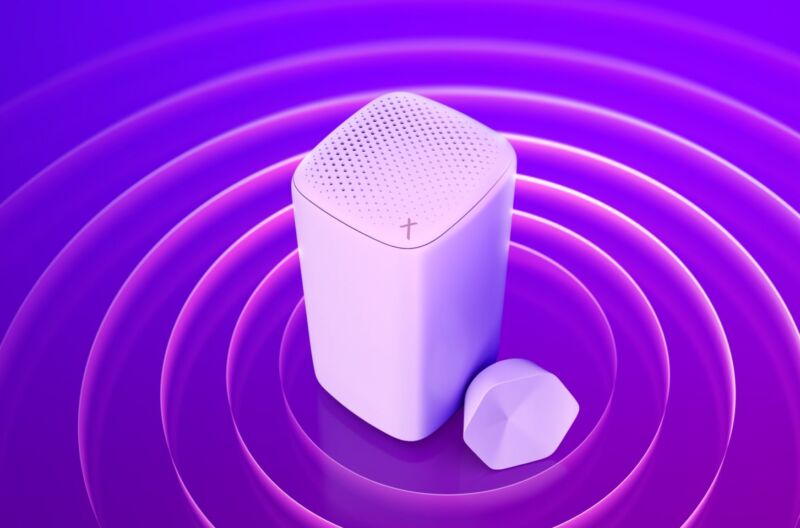
Some T-Mobile customers in Oregon and Utah will be the first to make phone calls over 5G as the carrier begins switching voice calls over to 5G from its older 4G LTE network, one city at a time.
5G for voice calls will start to roll out for T-Mobile customers in two Western states first.
T-Mobile
Those customers likely won't notice any difference in phone call quality, but it's an important move for T-Mobile. Switching these technologies will free up resources to allow better and faster wireless connections in the future, which are especially important for upcoming tech like self-driving cars and virtual reality.
"We're trying to create this big, broad, capable network and figure out what people want to do with it. What are the use cases? Where's the demand?" said Grant Castle, vice president of device engineering and technology labs at T-Mobile.
T-Mobile's moves toward 5G voice are the latest in the years-long rollout of the technology. While companies have been selling 5G-capable phones for three years since the Samsung Galaxy S10 5G launched in early 2019, the wireless technology itself has been coming online in stages. As carriers have built out their networks, consumers with 5G phones have been seeing better speeds and coverage. But not every part of the process to switch wireless networks from 4G LTE to 5G will mean noticeable improvements for consumers.
Everyday phone users won't see these benefits when they start making 5G calls this year, as current apps aren't that data-hungry. So if you're calling someone over 5G and want to look up a restaurant on Yelp, for instance, you won't see it necessarily load faster than you did on 4G LTE. At most, you'll see a shorter delay between when you dial a number and when it starts ringing on the other end, according to a T-Mobile press release.
T-Mobile tested its new 5G calling in Portland, Oregon, and in Salt Lake City, Utah, for months, using the time to fix bugs and ensure the system worked well before activating 5G calling for customers. It'll take the rest of the year to make the technology more broadly available across the country as T-Mobile slowly expands 5G calls to more cities.
Customers won't have to pay more to get 5G calls, but they'll need newer phones to make them. At launch, only the Samsung Galaxy S21 5G series can make VoNR calls on T-Mobile's network, but the carrier plans to expand compatibility to more devices later on, including this year's Samsung Galaxy S22. While Castle wouldn't specify any other phones, he did say that some older devices won't be able to make calls over 5G, including some currently being sold in its stores.
The shift toward 5G phone calls is a milestone in T-Mobile's journey to a standalone 5G network. T-Mobile was the first carrier to turn on a 5G-only network that didn't lean on 4G LTE, back in August 2020, and has kept its lead over the other carriers. Verizon was expected to launch its so-called standalone 5G core in 2021, but that slipped to 2022, per SDXCentral, while AT&T is waiting for more 5G devices to get in users' hands before activating their standalone 5G, according to Fierce Wireless.
The state’s implementation of a new drug prevention and treatment network to help tens of thousands of people with addiction problems appears to be back on track after months of delays caused in part by mismanagement and misjudgment by the Oregon Health Authority.
That was one of the main messages in a presentation Thursday to a state House committee by Ian Green, performance audit manager for the Secretary of State’s Office. Auditors are doing an ongoing or “real time” audit of the implementation of Measure 110, which was approved by voters in November 2020.
The measure decriminalized the possession of small amounts of drugs while creating a new prevention, treatment and recovery system based on a network of services in each county.
The delay in setting up those networks comes as Oregon’s addiction crisis worsens, with a spike in overdose deaths and widespread availability of methamphetamine and potentially deadly opioids. Oregon has the third highest addiction rate in the country and ranks last in access to treatment, according to national surveys.
Measure 110 dedicated about $150 million a year in marijuana tax revenue for addiction prevention, treatment and recovery.
This funding was intended to bolster community services to treat people with an addition to drugs or alcohol, including with more recovery services and special housing. County networks are supposed to communicate with each other to share information, and they are supposed to make it easy for patients to access services. The measure also emphasizes equity and cultural competence in services.
The new system was supposed to have been approved January. Instead, a state oversight committee just finished reviewing about 240 applications from organizations seeking to get a share of the new funding.
Part of the delay, according to the audit, is that the Oregon Health Authority did not provide enough support to the state review committee. It is made up of volunteers who have personal experience in drug addiction but no experience designing and implementing a grant program, auditors found.
The committee can’t complete funding “without sufficient administrative groundwork being performed by OHA,” Green testified.
In May, the health authority announced it would step up staffing for the committee.
Green said one problem was that the measure itself was vague about the system.
“The lack of clarity around roles and responsibilities has contributed to delays, confusion and strained relations,” Green said, noting that “as a first-in-the nation program, implemented during a pandemic, the challenges we note are not surprising.”
As a result, the review committee had an inadequate process for reviewing grant requests, the audit said. The state agency hasn’t deployed enough management and oversight to ensure that providers offer equitable access to services. The agency has still not finalized data collection and monitoring, the audit said.
Steve Allen, Oregon’s behavioral health director, acknowledged in legislative testimony Thursday that the state had fallen short.
“Ballot Measure 110 has not been implemented without some bumps along the way and some significant bumps along the way,” Allen told legislators. “We have made some missteps at the Oregon Health Authority, including myself.”
He said the agency underestimated the number of grant applications it would receive and the amount of time it would take for review.
He said missteps were to be expected.
“Anyone who has worked to implement a $300 million project in a way that’s never been done before, we would expect some bumps along the way,” Allen testified.
With the reviews finished, the state is negotiating contracts. The money is divided among the state’s 36 counties based on population, Medicaid population, number of homeless people, drug- and alcohol-related arrests and drug overdose deaths. Providers in Multnomah County, with more than 815,000 people, will get the most – $50 million. Wheeler County, with a population of nearly 1,500, will get nearly $91,000.
Allen said the state set a goal of funding providers three weeks after the contracts were signed. He said the agency is surpassing that goal by releasing funds within 10 days in many cases.
“That part of the process is working really quickly,” Allen said.
Green welcomed the recent progress.
“These are promising signs that Measure 110 implementation is back on track, despite earlier setbacks and repeated delays,” he testified. “Adopting our recommendations should mitigate risks that could further delay implementation.”
The Secretary of State’s Office will continue to audit the program’s implementation and will provide another update in the fall.
The state’s timeline shows that the implementation will stretch to October.
The top hat and rabbit can rest. FitzMagic is calling it a career.
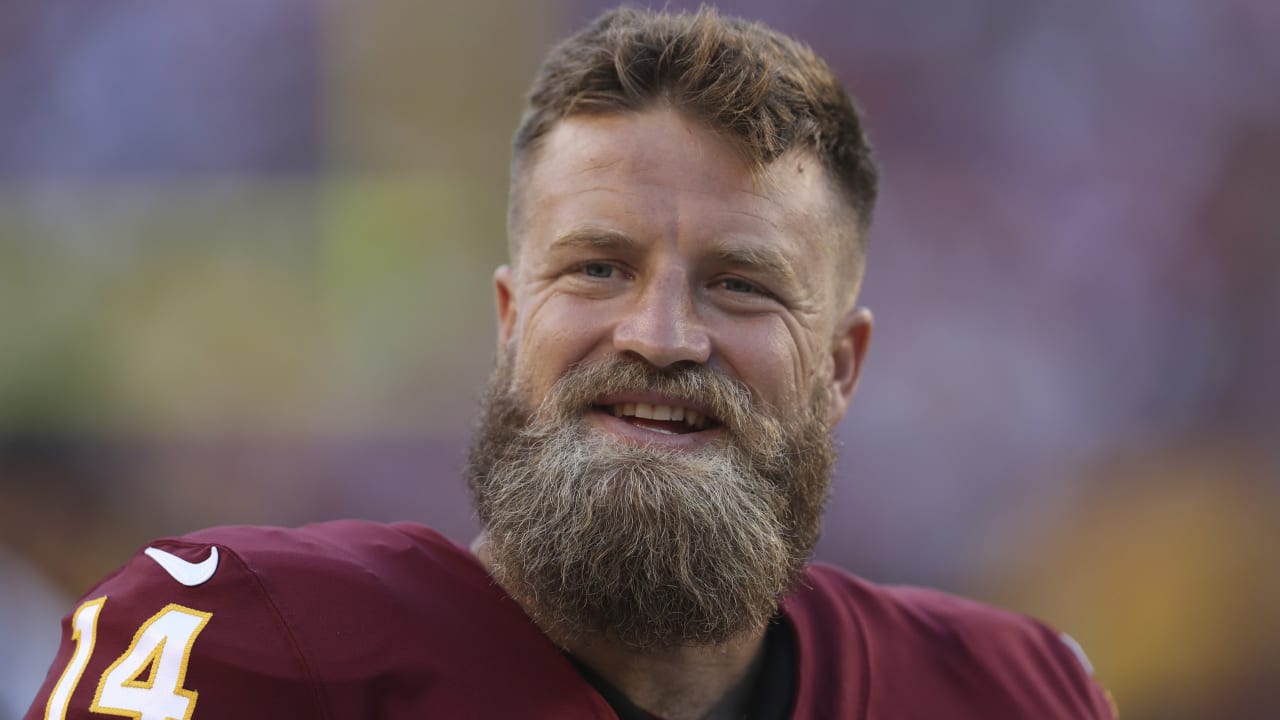
Ryan Fitzpatrick is retiring after 17 NFL seasons, NFL Network's Tom Pelissero reported Thursday. Fitzpatrick is in talks with Prime Video for a key role in Amazon's NFL coverage this season, NFL Network Insider Ian Rapoport added.
Fitzpatrick's NFL journey was as unlikely as it was thrilling. The Harvard product entered the league as a seventh-round pick (250th overall) of the St. Louis Rams in 2005, the last quarterback selected in that draft. What followed was a trying, but magical career filled with uniform changes -- he started at least one game for nine different NFL teams, the most by any player since at least 1950 -- and heart-stopping moments.
There was Fitzpatrick's showdown with Pittsburgh's Ben Roethlisberger on Monday Night Football in 2018, a game in which Fitzpatrick completed 30 of 50 passes for 411 yards, three touchdowns and three interceptions, and threw for 430-plus yards for a second straight week. The aerial assault captivated the football viewing nation, but as was the case for much of Fitzpatrick's career, it ended in a 30-27 defeat. In 2015, Fitzpatrick nearly led the New York Jets to an unlikely playoff berth in their first season under coach Todd Bowles, but after winning five straight games between Weeks 12-16, the Jets fell just short of the postseason, losing to Buffalo 22-17 in Week 17.
And there was, of course, the legendary 2018 postgame presser in which Fitzpatrick wore teammate DeSean Jackson's track suit, complete with a gold chains and a pair of aviator sunglasses.
Fitzpatrick didn't compile a Hall of Fame career, but he certainly made it worth watching, both on and off the field. Fitzpatrick threw a touchdown pass to 62 different players in his career, coming in behind a trio of passers (Tom Brady, Drew Brees, Vinny Testaverde) who have thrown a touchdown pass to more than 62 different players in NFL history. He became known for authoring thrilling finishes, no matter for which team he was playing, and the lone disappointment came with the territory he didn't reach: the postseason. Fitzpatrick's 34,990 passing yards are the most in NFL history by a player who never played in a playoff game, and stand as the 32nd most in league history.
Still, considering where he began, Fitzpatrick outperformed his odds by a wide margin. He owns the most career passing yards among all quarterbacks drafted in the seventh round of later in the common draft era, outperforming 1977 10th-rounder Steve DeBerg by 749 yards and standing well ahead of Super Bowl XXXVII champion Brad Johnson. Fitzpatrick is the only quarterback in NFL history to win a game with seven or more different teams (Miami, Tampa Bay, New York Jets, Buffalo, Houston, Cincinnati, Tennessee). He also is tied for the seventh-most career seasons by a quarterback since the 1970 NFL-AFL merger, trailing only Brady, Testaverde, Brett Favre, Dave Krieg and Ben Roethlisberger, and he's one of only 30 quarterbacks in NFL history with 34,000-plus passing yards and 220-plus passing touchdowns in a career.
Fitzpatrick first saw the field as a result of an injury to Rams starter Marc Bulger and appeared in four games (three starts) in 2005, going 0-3 as a starter. He didn't throw a pass in a game for the next two seasons, continuing a pedestrian career typical of a late selection, but 2008 is when things started to change for Fitzpatrick.
St. Louis traded Fitzpatrick to Cincinnati for a seventh-round pick in 2007, and the quarterback ended up starting 12 games for the Bengals in place of the injured Carson Palmer. He went 4-7-1 as a starter and impressed other NFL clubs enough to earn a three-year deal with the Buffalo Bills in 2009. Another injury to a starter -- this time, Trent Edwards -- opened the door for Fitzpatrick to prove his worth, and by the 2011 season, Fitzpatrick had done enough to earn the starting job in Buffalo for the 2011 and 2012 seasons.
Thus became the theme for Fitzpatrick's career: Sign with a team, battle for a roster spot and eventually find his way to the field due to an injury to a starter. It happened in Tennessee in 2013 and Houston in 2014. In 2015, Fitzpatrick found some stability with the New York Jets (due in part to a locker room altercation that forced Geno Smith out of action), keying an exciting season that nearly saw New York reach the postseason. He remained for one more season before moving to Tampa, where he replaced injured starter Jameis Winston in six games (three starts) in 2017 and appeared in eight games (seven starts) in 2018, posting a 24-15 touchdown-to-interception ratio between 2017 and 2018.
Fitzpatrick rarely joined a team with firm footing as the top option under center, but in 2019, his move to Miami saw him serve as the starter for all but three games. He nearly led Miami to an unlikely playoff appearance a year later, beginning the season as the starter before Miami forced rookie Tua Tagovailoa into action following the team's bye week. Left to watch on the bench, Fitzpatrick suddenly heard his number called in a moment of desperation in a Week 16 game at Las Vegas.
Fitzpatrick promptly entered the game and found himself facing a do-or-die fourth down situation. He dropped to pass and heaved a prayer as the Raiders' Arden Key delivered a blow to Fitzpatrick's facemask, buying the Dolphins a fresh set of downs via a roughing the passer penalty with just enough time for two more plays. Jason Sanders' 44-yard field goal sent the Dolphins to a win.
Fitzpatrick moved onto Washington in 2021, where he was named the starter but lasted less than one game. A partially dislocated hip forced him out of action in Week 1 and effectively spelled the end of his career.
At 39 years old, Fitzpatrick is walking away from a lengthy career he shared with hundreds of teammates he befriended along his winding journey. The Harvard product was never supposed to last this long. He can walk away from the game satisfied with the remarkable achievement that was his NFL voyage – and begin preparations for his transition to broadcasting.
A group of education leaders founded Great Minds®️ in 2007 to advocate for a more content-rich, comprehensive education for all children. In pursuit of that mission, Great Minds brings together teachers and scholars to create exemplary instructional materials that provide joyful rigor to learning, spark and reward curiosity, and impart knowledge with equal parts delight.
Great Minds supports teachers with curriculum materials and implementation products and services in math, English, and science. Our curricula are Eureka Math®️, Wit and Wisdom®️, Geodes®️, and PhD Science®️. Last year, the Eureka Math teacher–writers created Eureka Math Equip™, an adaptive digital diagnostic tool designed to help teachers identify student learning gaps and address them through direct instruction and fluency practice.
Eureka Math Equip premodule assessments provide educators with a snapshot of a student’s grasp of the essential foundational knowledge that will be needed in upcoming lessons. We believe it should become standard practice to have students complete these assessments throughout the school year before beginning a new module.
“I think my kids are better at word problems than they ever were before. Many of the routines sound strange, however, it all comes together eventually.”
“We have been using Eureka Math for a year now. Like any new curriculum, it takes a bit to learn how to use it. We have tailored it to what fits our needs, as you also do with any curriculum. I am amazed at how our students’ scores soared. The professional development our district received was amazing and very helpful. I highly recommend the Eureka Math curriculum.”
What Users Dislike About the App
“My granddaughter’s second-grade teacher is using the Eureka Math Common Core workbook in her classroom. It is horrid. Copies of workbook pages are being sent home in her weekly homework packet. I believe this is a MANDATED curriculum. I have not seen the entire book as only a handful of pages come home weekly. I have seen enough that my eyebrows have popped up. Some of the directions are not written in clear “math” language. My granddaughter, who is far beyond this math level, was confused by some of the directions. There is no need for this. The authors need to keep it simple and nail the concepts.”
“It’s really good in parts and other parts it doesn’t meet the objectives. Overall we like it, but there’s no way I have the time it takes to do everything they suggest. I adjust it to what my students need, but I would do that with any program.”
“We have found that there is no built-in spiral review for second graders. There is only one week of graph lessons. After one lesson ‘reviewing’ change, the only other money lessons are word problems. Time is taught as fractions of the hour on the analog clock. They spend a lot of time on new strategies. The mindset seems to be “teach a lesson and move on.” We had to squeeze in time to re-teach. We were also told not to send home the homework because it confuses parents.”
“It’s not a program which you can pick out stuff. Each component of a daily lesson is integral to the lesson. It’s very boring. They expect kids to write all the stuff down in a really short time frame. Our district math specialist couldn’t do a whole lesson in the allotted time.”
“Our district has Eureka Math and as a parent, I hate it. (My husband and I are certified teachers, but not in Math. My high school math background was Algebra 1 & 2, Geometry, Trig, Stats, and Physics.) They use it in elementary/middle school but now we have a child in high school. It is awful in Algebra, this fall we will see how it is for Geometry. Our district doesn’t provide books, all work is done on chrome books and iXL. There is nothing for our daughter to go back to and see examples and understand how the equation worked out. When I try and help her, there is nothing for me to go back and refresh my memory on for how to complete the task. Then it has her solve it 3 different ways, again, no explanation on what the 3 methods should look like (story problem, visual, straight solving with showing the work, etc.). I actually purchased 3 of the books (5 modules) to try and help our daughter, but the books were worthless. Our school district says our scores are going up but I think that is in the elementary not in the high school. The districts around us do not use Eureka.”
"Attendees will find many changes to enhance their experience at the show in 2022. When we re-branded and renamed the event last year from GIE+EXPO to Equip Exposition, attendee feedback was clear. They wanted more time -- outside to try out equipment, to attend education sessions and to network, swap ideas and learn how to grow profitability," says Kris Kiser, President & CEO of the Outdoor Power Equipment Institute (OPEI), which owns and manages Equip Exposition. "We've heard them and are giving show attendees many new experiences, and most importantly, more hours at the show."
Of the many improvements this year, the ever-popular Outdoor Demo Yard, where attendees can "test before they invest" in new equipment to see if it's right for their businesses, has expanded by nearly 8 acres – and is now nearly 30 acres. Before committing to purchasing equipment, contractors and landscapers can drive, dig, mulch, cut, trim, mow, saw and more to see how the equipment handles and performs.
"Companies that have never reserved outdoor demonstration areas to show their products are lining up to be outside this year," says Kiser.
An expanded UTV test track also will be available in the Outdoor Demo Yard. Drivers must be at least age 16 and have a valid driver's license to drive one of the UTVs.
Hours for the trade show are also increasing, both for the indoor exhibition area, which boasts 1,000+ exhibitors covering 675,000 square feet of exhibit space, and for the expanded Outdoor Demo Yard.
Overall, the show opens earlier on Wednesday, starting for dealers at 9 a.m. and for landscape contractors at 12 p.m.
Outdoor Demo Yard hours also start early with additional Wednesday hours from 12 p.m.-5 p.m.
Additional enhancements to the show include:
Registration moving to the North Wing Lobby of the Kentucky Exposition Center (KEC).
An express pickup line for attendees who are pre-registered on Wednesday at the KEC, allowing them to scan their registration bar codes and quickly print badges.
Kiosks in the South Wing lobbies where attendees can scan their bar codes and print badges. Select hotels will also offer express pickup and registration starting on Tuesday.
A first-ever Welcome Reception at Louisville Slugger Field sponsored by Husqvarna and Louisville Tourism for all attendees to enjoy food and fireworks, on Tuesday, October 18 from 6:30 p.m-9 p.m.
The inaugural Mulligan's Fun Run 5K, sponsored by Ariens Co. and the TurfMutt Foundation that will benefit the Kentucky Humane Society. Run/walk across the Ohio River on the city's Big Four pedestrian bridge and in sight of Louisville's Great Lawn kicking off Wednesday morning, October 19, starting at 7 a.m.
A closing Keynote & Breakfast sponsored by RYOBI on Friday, October 21 at the KEC to close out the show, which includes a keynote address from National Geographic's Photo Ark creator Joel Sartore.
New education tracks for landscapers focused on Leadership, Technology, Sales & Profitability, Grow Your Team, Pool and Spa, Landscape Lighting, Tree Care, and Hardscaping.
Expanded education for dealers on succession planning, profitability, and new technologies.
Show management also heard attendees on better food and drink options at the KEC. Changes include:
A new Equip Expo Coffee House sponsored by EGO located in South Wing Lobby C.
Freedom Hall becoming a food hub, in addition to hosting Lucky's Mutt Madness and tree climbing workshops. Expect food trucks and three days of themed buffets (Taste of Kentucky, Southern BBQ, Little Italy) and more.
After a busy day seeing the latest innovations in the industry, attendees won't want to miss the evening concerts. The show's house band, The Crashers, kicks things off on Wednesday night. The premium concert event featuring country music star Trace Adkins moves to Thursday evening at Fourth Street Live! and is sponsored by STIHL on the Belgard Stage.
Equip Exposition continues to co-locate with Hardscape North America (HNA), the premier trade show for hardscape contractors, presented by the Interlocking Concrete Paving Institute and National Concrete Manufacturers Association. Registration at Equip Exposition gets attendees free access to the HNA show.
For information on exhibit space sales and sponsorships, contact the Equip Exposition office at [email protected] or call 502-536-7050.
Media contacts Ami Neiberger, Four Leaf PR on behalf of OPEI, 703-887-4877, [email protected] Debbi Mayster, Four Leaf PR on behalf of OPEI, 240-988-6243, [email protected]
About Equip Exposition
Equip Exposition, the international landscape, outdoor living, and equipment exposition, is held annually in Louisville, KY, and in 2019 was ranked the sixth largest trade show in the United States. The show publishes equip magazine and is owned and managed by the Outdoor Power Equipment Institute, an international trade association representing manufacturers of outdoor power equipment, parts, small engines, battery power systems, portable generators, utility and personal transport vehicles, and golf cars, and their suppliers. For more information visit www.equipexposition.com.
"equip" - Google News
June 02, 2022 at 07:50PM
https://ift.tt/uYwURGP
Keep Your Business on the Cutting Edge with Equip Exposition: Trade Show Hours, Demo Yard & UTV Test Track Expand - PR Newswire
"equip" - Google News
https://ift.tt/FWM1vwJ
https://ift.tt/WtOkuwB
Most organizations run their enterprise data network as though it comprises three separate and largely independent networks.
The campus network includes the LANs to which most end-user and IoT devices are attached. The WAN connects campus networks to each other, to data centers and to clouds. And the data center network connects server applications to data on networked storage, to users, and to other applications and services located elsewhere.
Each of these network segments uses network virtualization to ease traffic management and security. Those virtualization efforts are also conceived and managed separately.
As demands rise for more seamless automation, nimble network services and tighter security, the time has come for network teams to move past this legacy mindset of siloed networks. Zero trust is unifying overall enterprise cybersecurity; it can unify virtual networking as well.
Virtual networks are the key to zero trust
In an ideal world, every network in a zero-trust environment is dedicated to just the endpoints that must communicate and the ports and protocols they need to do so. It is secured cryptographically and uses identity-based session control. And it exists only for as long as the current conversation.
This model isn't practical, or even possible, with traditional physical networking. Virtual networks are the only way to achieve this kind of secure connectivity, as they can be spun up when needed, torn down when they're no longer needed and overlaid on shared infrastructure without compromising traffic segmentation.
Virtual networks can also be encrypted end to end and act as point-to-point dedicated VPNs for a given conversation. Endpoints can conduct simultaneous conversations on separate, ephemeral VPNs, with conversations invisible to any entity that isn't party to them.
A whole network -- not a network full of holes
In a zero-trust environment, access policies focus on which entities need to talk to which other entities. That simple fact argues for the unification of all virtualization environments at the policy level. After all, if user A on machine M is allowed to reach a service in the company data centers, then policy has to allow it at the campus level, across the WAN and into the data center. The security environment requires the same policy to be known in all segments and requires all segments to enforce policy.
This big-picture security view requires cross-domain thinking. It also creates cross-domain opportunities beyond security. In a unified virtualization environment, IT teams could implement end-to-end visibility of network communications generally and apply end-to-end optimizations as well. For example, teams could prioritize traffic as it bounces around a data center, crosses a WAN and navigates the LAN from which an end user is working. That prioritization could be based on any aspect of the session -- who the user is, what the program is, what its protocols demand, where the endpoint is and what time it is.
IT could also provide programmatic access to the network from end to end, via a network controller. This access would make it possible for development teams to tweak the settings on the channels their applications' traffic would traverse -- within a governing set of rules for safety, of course.
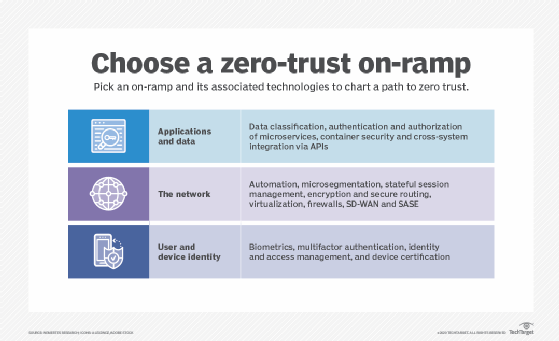
Enterprises can pursue zero-trust strategies within the network using automation, segmentation and virtualization.
Challenges of unified network virtualization
What needs to talk to what?
As with every zero-trust effort and microsegmentation initiative, one of the biggest challenges in a comprehensive network virtualization implementation is figuring out which entities need to talk to which other entities.
Most organizations know only part of the picture and resort to monitoring ongoing communications over time to fill in their knowledge gaps. Some designs enable IT to set up policies that do extra monitoring and alerting on unexpected traffic before clamping down and blocking it, for example. Or IT can deploy specialized application mapping tools.
Zero trust, while shaking up and unifying overall enterprise cybersecurity around a consistent approach to security, can provide the impetus for unifying virtual networking as well.
Aging infrastructure
Another significant challenge is dealing with aging infrastructure. It is not unusual for an organization to keep seven- to 10-year-old equipment online, and it may not all be able to participate in the chosen zero-trust architecture. An intermediary can sometimes supplement such systems, but the time and trouble of implementing one are probably greater than the cost of updating the hardware.
IT will need to revamp internal processes that touch everything from network deployments to change management reviews. The changes shouldn't be enormous, but it's crucial that teams ensure none of the processes presume the three network domains are siloed off from each other.
Teams working together
Another challenge is getting all the different network teams to work together on the architecture, product selection, engineering and implementation. Making such a radical, transformative change to the status quo is difficult, as it touches everything from job descriptions and annual goals to workloads and skill sets.
Success requires persuasion, education, clear vision, incentives, consistency and firmness of purpose at the leadership level. Staff members need time to learn to think about what they do differently, learn new skills and implement the new world, all while keeping the old systems ticking over as usual.
All these challenges are tractable, especially in the context of transformative changes. Zero trust, while shaking up and unifying overall enterprise cybersecurity around a consistent approach to security, can provide the impetus for unifying virtual networking as well.