Football fans across America have long called for the Monday after the Super Bowl to be recognized as a national holiday, for obvious reasons.
However, NFL Network host Kyle Brandt has a better idea, move the big game to Saturday.
Kansas City Chiefs place kicker Harrison Butker, #7, unsuccessfully attempts a field goal against the Philadelphia Eagles during the first half of the NFL Super Bowl LVII football game, Sunday, Feb. 12, 2023, in Glendale, Arizona.(AP Photo/David J. Phillip)
The league announced last year that for the first time ever, it will schedule a 3 p.m. game on the Friday after Thanksgiving. During an appearance on "SI Media with Jimmy Traina" on Thursday, the "Good Morning Football" host shared his enthusiasm over the scheduling change, but added that the NFL should not stop there.
"I think the Black Friday game walks so that Super Bowl Saturday can run. I’ve been pushing for that for years. I want Super Bowl Saturday."
Brandt continued, "I got to interview [Roger] Goodell once. Goodell and I have a very comfortable, jocular relationship, and I pitched him on the air, ‘Super Bowl Saturday, Roger.’ And I just wanna speak for the people – Yes, if you’re thinking it’s because I wanna drink and eat with impunity, yes, that’s the reason why. Why can’t we make this on Saturday? And he laughed, but he gave the answer, ‘well the audience on Sunday blah, blah, blah,’ and I get it, but I don’t care. I want it on Saturday."
NFL Network host Kyle Brandt presents on stage during round three of the 2022 NFL Draft on April 28, 2022 in Las Vegas.(Kevin Sabitus/Getty Images)
Earlier this year, lawmakers in Tennessee proposed a bill to recognize the Monday after the Super Bowl as a state holiday in place of Columbus Day.
However, according to data collected by the WorkForce Institute, a change might be necessary to combat many absences and a lack of productivity in the office.
Philadelphia Eagles quarterback Jalen Hurtsk #1, reacts after their loss against the Kansas City Chiefs in the NFL Super Bowl LVII football game, Sunday, Feb. 12, 2023, in Glendale, Arizona. Kansas City Chiefs defeated the Philadelphia Eagles 38-35.(AP Photo/Ross D. Franklin)
Their research from early February indicated that 18.8 million people may miss the day after the Super Bowl, while 33% of people would be less productive than usual on that Monday.
Germany's transport network is at a near standstill as two of the country's largest unions strike.
Staff at airports, ports, railways, buses and subways walked out shortly after midnight for a 24-hour stoppage.
Unions are demanding higher wages to help their members cope with the rising cost of living across the country.
There have been multiple smaller walkouts by other public service sectors, but Monday's is expected to be the largest in decades in the country.
Commuter and regional trains operated by Deutsche Bahn, Germany's national rail operator, have been affected.
Local transport services, including trams and buses, are also not in operation in seven states.
"Petrol and food prices have risen," one protester in Berlin told the AFP news agency. "I'm feeling it in my wallet."
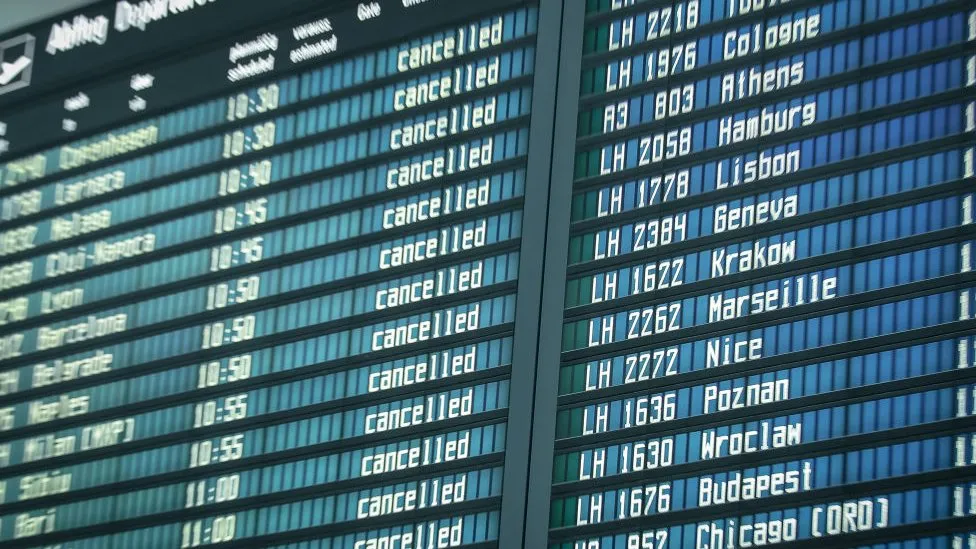
Thousands of flights have been cancelled, including at two of the country's biggest airports - Munich and Frankfurt.
Multiple departures from Munich Airport were also disrupted on Sunday by strike action.
"I am a bit shocked actually," said one man, who was trying to fly to the Spanish city of Málaga. "I didn't hear of it [the strike], so I have to find out what to do right now."
Germany's airport association said about 380,000 air travellers would be affected by the strike but added it was "beyond any imaginable and justifiable measure".
Jenny Hill, the BBC's Berlin correspondent, said it was very rare for a dispute over pay to escalate so dramatically in Germany, but this time two of the country's largest unions have joined forces.
Verdi represents about 2.5 million employees across the public sector, including in public transport and at airports. It wants to secure a 10.5% pay rise for staff.
EVG represents about 230,000 employees at Deutsche Bahn and other bus companies. It wants a 12% rise in pay.
Both unions hope the strike will increase pressure on employers ahead of another round of pay negotiations this week.
In an interview with the German newspaper Bild, the chief of Verdi, Frank Werneke, described the pay rise as "a matter of survival for many thousands of employees."
"The people are not only underpaid, they are hopelessly overworked," he said.
Deutsche Bahn is among the organisations that have condemned the strike, describing it as "completely excessive, groundless and unnecessary".
Some employer representatives have also warned the unions are making unreasonable demands that risk alienating the public.
Nevertheless, successful wage increases have been negotiated recently. Postal workers won an 11.5% pay rise in early March.
Monday's strike follows a similar walkout in February. More than 2,300 flights were cancelled and representatives of small and medium business associations accused the unions of taking the whole country hostage for their own interests.
There have also been multiple walkouts by other public service sectors in recent weeks, including childcare and education.
Germany's transport network will be at a near standstill on Monday as two of the country's largest unions strike.
Staff at airports, ports, railways, buses and subways walked out shortly after midnight for a 24-hour stoppage.
Unions are demanding higher wages to help their members cope with the rising cost of living across the country.
There have been multiple smaller walkouts by other public service sectors, but Monday's will be the largest in decades in the country.
The two unions involved in the strike are among the largest in Germany.
Verdi represents around 2.5 million employees across the public sector including in public transport and at airports.
EVG represents around 230,000 employees at Deutsche Bahn - Germany's national rail operator, and other bus companies.
They hope it will increase pressure on employers ahead of another round of pay negotiations on Monday.
Frank Werneke, the chief of Verdi described the pay rise as "a matter of survival for many thousands of employees, according to local media.
"The people are not only underpaid, they are hopelessly overworked," he said.
Verdi wants to secure a 10.5% pay rise for staff, while the other union involved, EVG, wants a 12% raise.
Germany's national rail operator, Deutsche Bahn, condemned the plans and described it as "completely excessive, groundless and unnecessary".
At Munich Airport on Sunday, multiple flights were disrupted by the walkout.
Germany's airport association said about 380,000 air travellers would be affected by the strike but added that it was "beyond any imaginable and justifiable measure".
Some employer representatives warn the unions are making unreasonable demands which risk alienating the public.
However, some unions have succeeded in winning wage increases, including postal workers who won an 11.5% pay rise in early march.
As a modern alternative to the traditional router, you would be forgiven for thinking that a mesh router would automatically be "better" in all cases than a simple, standard device. However, this isn't always the case.
We now have to give more thought to the underlying connectivity in our homes. Mobile devices, including smartphones and tablets, and Internet of Things (IoT) devices, ranging from security cameras to smart appliances, have all increased the load shouldered by our routers.
Furthermore, the COVID-19 pandemic changed the face of modern work by introducing remote and hybrid working to the population at large. Despite the resistance of some companies to continuing these arrangements, home offices are likely to be a common feature in homes for the foreseeable future.
This is where mesh networks come in. Designed to lighten the endpoint load and reduce congestion, mesh systems can be invaluable for maintaining connectivity, but they aren't suitable for every household. In some cases, you only need a high-quality standard router, whereas a mesh network could be overkill. When it comes to speed, Wi-Fi routers (and LAN cabling) are often king.
ZDNET explains the difference and why you should adopt a mesh network over a traditional router system -- and vice versa.
What is a traditional router?
A traditional router acts as a central hub for Internet connectivity. Traffic requests from devices funnel through a main router's internet service and a single access point. Routers can be accessed through wireless channels or by plugging in an Ethernet cable. Typically, these routers are password-protected.
You should buy a traditional Wi-Fi router if...
Getty Images
1. Affordability is a consideration
Standard routers are generally more affordable than mesh network products. While you still may expect to pay hundreds of dollars for a premium router, there are many options that are budget-friendly and both quick and stable enough to keep your home office running effectively without further input.
2. You have heavy bandwidth and speed requirements
Many routers today, such as the Netgear Nighthawk or TP-Link models, are designed with the technology needed to meet heavy bandwidth and streaming requirements.
Gamers and live streamers, for example, should generally stick with wired Ethernet connections and traditional routers, as they will likely provide improved speeds and stability over wireless-first products.
3. You want a plug-and-play product
A standard router is often less hassle to set up than a mesh network. For something that 'just works,' a typical router might be the best option. Set it up, make sure updates are automatically applied, and forget about it.
4. You want to separate devices and networks
You can set up guest Wi-Fi networks on most modern routers, but if you also want to keep all of your IoT devices on a separate home network in the interests of security, most routers will allow you to do this without much hassle.
While traditional routers are singular, centralized access points, mesh networking devices are decentralized.
Instead of a device connecting to a single gateway to the Internet, mesh networks are created from multiple Wi-Fi nodes that all provide web connectivity. For example, you could have a central hub in the kitchen and satellite nodes in the home office, kitchen, and bedroom.
When you access the internet while in the kitchen, you would automatically connect to the hub, whereas you would jump on a node while you're in your home office, and so on -- and this blanket coverage is why mesh devices are great for larger homes or offices. Most mesh systems will automatically select the best channels and nodes to avoid dead zones and to lower the risk of poor connectivity.
You should buy a mesh networking system if...
Amazon
1. Improved coverage
The main benefit of a mesh network is extended coverage. Investing in a mesh setup will remove annoyances such as coverage blackspots or slow connections in larger properties with a lot of square feet. You're far less likely to have dead zones with a mesh system than you are with a single router access point.
Mesh networks can often cover up to 5000 sq. ft. with enough satellites. That's far more than you can expect from one central router.
2. You need a reliable connection, no matter where you are
As your device will connect to the nearest satellite node rather than a central point of access, this helps ensure that no matter where you are on a property, you are less likely to experience connectivity failures or drops.
In this manner, mesh networks are particularly useful if you have a home office in a garden area separate from your house, for example.
3. You want additional controls
Once a mesh network is active, many vendors allow users to control their system through a mobile app. This could include keeping an eye on network traffic, rebooting, or even turning off the Internet entirely -- perhaps an appealing prospect for those with children who don't want to mess with a typical router's configuration. In addition, some mesh networks also act as smart hubs and are compatible with voice assistants.
There are three key disadvantages of using a traditional Wi-Fi router.
Coverage issues: As Internet access is distributed through a single point, this can mean that areas far away from your router will have slow or spotty connections that drop. Range extenders can help remove this barrier, and while they can still be cheaper than investing in a mesh network, it's an additional expense.
Overload: Unless extenders or channel separation features are used, too many connections may result in overloading, bottlenecks, lags, and connectivity drops.
Tweaking: If you want to tweak the more advanced settings on a router, this can often require annoying visits to a platform via desktop, rather than the seamless mobile app connectivity we have learned to enjoy for many of our modern services.
You need to decide whether the financial outlay for a whole mesh network is worth it. In larger homes with dead spots, mesh networking can provide a way to improve your Wi-Fi signal strength and coverage immediately.
However, it can be expensive to overhaul your existing router setup for a large home. Going for a full mesh system may be overkill unless you consistently have multiple users and connected devices competing for bandwidth.
A Wi-Fi extender can be a worthwhile investment instead if you decide to stay with a traditional home router but need to expand coverage.
Some mesh network systems, such as Google Wifi, Netgear Orbi, and Amazon Eero, are relatively cheap to set up if you don't need too many satellites.
If you're the only person using your network and need a stable, powerful internet connection -- such as for resource-hungry work applications or gaming -- a traditional router and an Ethernet cable may be all you need for reliable and rapid Internet access. Wired internet speeds should be quicker than wireless if the connection is working properly, and investing in a simple Ethernet cable, easy to find for no more than $10 or $15, could be enough. This could save you the cost of a complete overhaul.
Wi-Fi range extenders, too, could be considered an alternative to mesh if you need to boost coverage and throughput in some areas, and they will likely be less expensive than purchasing individual mesh nodes. Some vendors also offer mesh "bolt-ons," such as Asus' AiMesh, which creates a mesh-like coverage wireless network without ripping everything out and starting again. However, the downside is that you will probably have to spend some time setting them up and tampering with your router's configurations.
The best way to answer this question is to consider latency. Overall, many mesh systems today trade extended coverage for potential downgrades to speed.
If your household has gamers using consoles casually, it shouldn't matter what type of router you use. However, professional and dedicated gamers will absolutely notice small lags or latency issues -- and they will want the best speed and stability available. In these cases, a wired, traditional router is likely your best bet.
While both mesh Wi-Fi and extenders will improve the coverage of your home, there are disadvantages to both.
Mesh systems require investment and the cost can add up quickly, but they provide seamless transitions between Wi-Fi access points dotted around your home. Furthermore, you can rapidly change settings or perform updates via mobile apps.
Wi-Fi extenders can't be tweaked so easily. However, they are cheaper and are the best option if you just want to tackle a few dead zones, as you just need to plug one into your main router. Keep in mind that unlike mesh nodes, Wi-Fi extenders won't improve congestion or eradicate bottlenecks.
Before changing your setup, you should review your ISP package. If you're subscribed to a low-speed offering, or your Internet provider throttles your speed at peak times, new equipment is not going to help. Instead, a package upgrade could be a better option.
Germany's transport network will be at a near standstill on Monday as two of the country's largest unions strike.
Staff at airports, ports, railways, buses and subways walked out shortly after midnight for a 24-hour stoppage.
Unions are demanding higher wages to help their members cope with the rising cost of living across the country.
There have been multiple smaller walkouts by other public service sectors, but Monday's will be the largest in decades in the country.
The two unions involved in the strike are among the largest in Germany.
Verdi represents around 2.5 million employees across the public sector including in public transport and at airports.
EVG represents around 230,000 employees at Deutsche Bahn - Germany's national rail operator, and other bus companies.
They hope it will increase pressure on employers ahead of another round of pay negotiations on Monday.
Frank Werneke, the chief of Verdi described the pay rise as "a matter of survival for many thousands of employees, according to local media.
"The people are not only underpaid, they are hopelessly overworked," he said.
Verdi wants to secure a 10.5% pay rise for staff, while the other union involved, EVG, wants a 12% raise.
Germany's national rail operator, Deutsche Bahn, condemned the plans and described it as "completely excessive, groundless and unnecessary".
At Munich Airport on Sunday, multiple flights were disrupted by the walkout.
Germany's airport association said about 380,000 air travellers would be affected by the strike but added that it was "beyond any imaginable and justifiable measure".
Some employer representatives warn the unions are making unreasonable demands which risk alienating the public.
However, some unions have succeeded in winning wage increases, including postal workers who won an 11.5% pay rise in early march.
Take, for example, the recent issues that Circle-issued USD Coin (USDC) faced when it depegged from the U.S. dollar following Silicon Valley Bank’s collapse. Two weeks later, Mastercard boldly integrated the stablecoin into its infrastructure in the Asia-Pacific region, allowing users to spend USDC through its network. It’s happening, folks!
And let’s not forget about Bitcoin (BTC) — that digital gold is still on the rise and decoupling from Wall Street, once again proving its value proposition and prompting calls for a hedge against equity markets in the long run.
This week’s Crypto Biz documents the latest developments on worldwide crypto adoption, and how banking system fears impact the crypto space.
Banks turmoil and regulatory crackdowns happening worldwide have not slowed down the ongoing blending of traditional and decentralized finance (DeFi). The on-ramps connecting the two sides seem even stronger despite the wild winds of change.
Mastercard to settle transactions for stablecoin wallet in APAC
Global payment provider Mastercard has made another move into the crypto space to allow retail customers in the Asia-Pacific region to spend stablecoins anywhere Mastercard is accepted. This move was made possible by a partnership with Stables, an Australian stablecoin platform. Users can spend and save USDC by converting it into fiat and settling on the Mastercard network. The wallet will accept deposits in several stablecoins, including Tether (USDT) and Binance USD (BUSD), with all deposits automatically converted into USDC.
MetaMask enables direct crypto purchases in Nigeria
On-ramps for digital assets are also increasing in Nigeria, as crypto wallet MetaMask expanded direct transactions with local banks. MetaMask’s parent firm ConsenSys has partnered with crypto fintech MoonPay, enabling users in the country to purchase crypto via instant bank transfers without requiring a credit or debit card. The integration is estimated to reduce the decline rate for direct crypto purchases in Nigeria from 90% to 30%. Nigeria is a major market for MetaMask, ranking third in mobile monthly active users. Chainalysis ranks Nigeria as one of the top 20 countries in cryptocurrency adoption.
Naija dey run things for MetaMask
Nigerians rank 3rd for active mobile users worldwide and are among the top 10 countries that visit https://t.co/uH8OHwxe2D. E be like say crypto dey hot for this side ohhttps://t.co/VTeUzwhR4o
OKX to cease operations in Canada by June 22, 2023
In a “temporary” bye-bye, crypto exchange OKX emailed Canadian users that the firm “will no longer provide services or allow users to open new accounts in Canada starting on March 24, 2023.” OKX cited “new regulations” behind the move, saying it is only temporary while it works with regulators. By June 22, OKX’s customers in the country must close open options, margins, perpetuals and futures positions. Fiat or tokens must also be withdrawn by that date. In February, The Canadian Securities Administrators published a notice requiring crypto exchanges to sign new, legally binding undertakings while they await registration with regulators.
Off-boarding message sent to Canadian OKX users on March 20, 2023.Source: OKX
Bitcoin’s banking crisis surge will ‘attract more institutions’: ARK’s Cathie Wood
With fears of a global banking crisis on the rise, Bitcoin’s value proposition is on full display as its price continues to climb following the collapses of Silvergate, Silicon Valley Bank and Signature Bank. ARK Invest CEO Cathie Wood believes the current decoupling of BTC’s price to the equity markets may attract more institutional investors into Bitcoin over time. As for the impact on Bitcoin’s price from institutional interest, Wood expects that most firms would allocate between 2.5% to 6.5% of their investment portfolios to BTC by 2030, taking the leading cryptocurrency’s price to $1–1.5 million.
ARK Investment Management CEO Cathie Wood says the behavior of the Bitcoin's price through the latest banking turmoil will attract more institutions and investors https://t.co/2d8cT7SX3npic.twitter.com/Eaymh05lhq
The impact of the Credit Suisse bank crisis on the crypto market
How to analyze banks and avoid inaccurate market capitalization indicators — such as the $15.8 billion value of Silicon Valley Bank? Crypto analyst Marcel Pechman delves into the enterprise value metric and how it provides a better picture of a bank’s balance sheet terms by subtracting net debt from market cap. Of course, Pechman first explains the relationship between banking valuation and cryptocurrencies, specifically Bitcoin’s ethos.
Crypto Biz is your weekly pulse of the business behind blockchain and crypto, delivered directly to your inbox every Thursday.